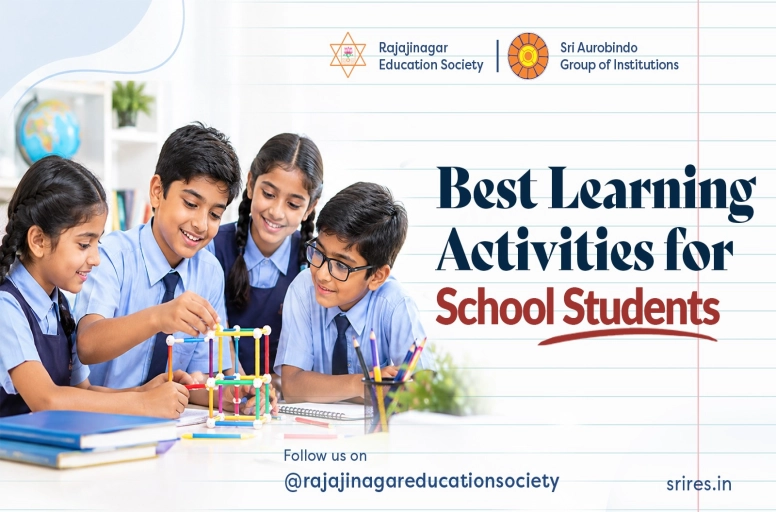
Best Learning Activities for School Students
Students can develop a deeper understanding of lessons when they investigate new ideas, experiment with different approaches, and take an active role in classroom activities. Engaging activities can help children develop confidence, creativity, communication skills, and problem-solving abilities. For a school community like Rajajinagar Education Society, activity-based learning can complement strong academic foundations. The right mix of classroom learning and practical experiences helps students become curious, independent, and responsible learners.
How Activity-Based Learning Supports Student Development?
Learning becomes more effective when students get opportunities to explore concepts through practical experiences, creative activities, and meaningful participation. Children learn more effectively when they can connect academic concepts with real life experiences. Learning activities encourage students to participate actively instead of simply listening or memorising information.
At Rajajinagar Education Society, such activities can support students in developing both academic understanding and essential life skills. Whether a child is beginning their journey in a primary school or preparing for higher classes, age-appropriate activities can make learning more enjoyable and purposeful.
1. Creative Art and Craft Activities
Art gives students an opportunity to express their ideas and imagination. Drawing, painting, paper crafts, clay modelling, and creative projects can improve concentration and encourage original thinking.
Teachers can connect art activities with subjects such as science, history, languages, and environmental studies. For example, students can create models of the solar system or design posters about environmental conservation.
Benefits of Creative Activities
- Encourages imagination and self-expression
- Develops fine motor skills
- Improves concentration
- Builds confidence in presenting ideas
2. Science Experiments and Practical Learning
Hands-on science demonstrations allow children to observe natural processes and understand difficult concepts through practical examples. Students can explore topics such as plants, water, air, light, magnets, and basic physics through safe classroom demonstrations and hands-on projects.
Practical learning encourages children to ask questions and discover answers through observation. These activities help students see how scientific concepts apply to situations and experiences they encounter in their daily lives.
3. Sports and Outdoor Learning
Regular physical activities support students’ physical fitness while also encouraging discipline, teamwork, confidence, and active participation. Team games, athletics, yoga, outdoor challenges, and recreational activities encourage students to stay active while learning valuable lessons about discipline and cooperation. Outdoor games and group challenges give students opportunities to practise leadership, build cooperation, and learn how to work toward shared goals.
4. Group Projects and Presentations
Collaborative assignments teach students to divide responsibilities, exchange ideas, and combine their efforts to achieve a common outcome. They learn how to divide responsibilities, communicate with classmates, manage time, and present their ideas.
These skills become increasingly important as students progress from primary education to secondary and higher levels. Schools aiming to provide a well-rounded learning environment can use project-based activities to complement academic teaching.
5. Cultural and Community Activities
Cultural programmes, celebrations, awareness campaigns, and community initiatives help students understand different traditions and social responsibilities. Activities such as debates, role plays, exhibitions, and awareness drives can encourage students to become thoughtful members of society.
Key Skills Students Develop Through Learning Activities
Well-planned school activities help children build essential skills that support their academic progress and personal growth. Such experiences help learners become more involved in their education, cooperate effectively with classmates, and respond positively to new challenges.
- Communication Skills: Share thoughts clearly and interact constructively with teachers and fellow students.
- Critical Thinking: Examine information carefully, raise relevant questions, and consider different approaches to solving problems.
- Teamwork: Collaborate with classmates and respect different perspectives.
- Creativity: Develop original ideas through art, projects, and hands-on activities.
- Leadership: Take responsibility, make decisions, and guide group tasks
- . Time Management: Organise tasks, allocate time wisely, and complete assigned activities within deadlines.
Building Well Rounded Learners
A strong educational environment should prepare students not only for examinations but also for real-life situations. For parents looking for an English medium high school or a best high school, opportunities for participation, creativity, communication, and leadership can be important aspects of a student's development.
Conclusion
The best learning activities are those that make students curious, involved, and confident. Creative projects, reading, experiments, mathematics games, sports, presentations, and community activities can complement classroom education and create richer learning experiences.