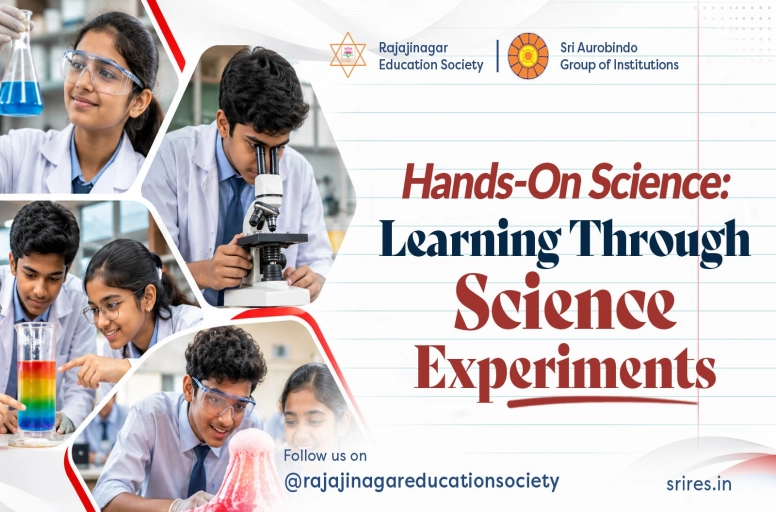
Hands On Science Learning Through Science Experiments
Science learning becomes more meaningful when students explore concepts through practical activities and real-world experiments. Hands-on experiments turn classroom concepts into discoveries that spark curiosity and imagination. They encourage students to ask questions, explore possibilities, and understand scientific principles through observation. By connecting theory with practical activities, schools can make science meaningful, enjoyable, and easier to remember.
From Classroom Concepts to Real-Life Discoveries
Reading about scientific principles helps students understand the basics, but performing experiments allows them to experience those principles in action. Whether observing a chemical reaction or studying the movement of objects, practical learning makes abstract ideas easier to understand.
For students pursuing science subjects, this approach develops a stronger connection between lessons and real-world applications. A supportive student focused learning environment gives learners the freedom to ask questions, share observations, and develop their own explanations.
Five Simple Experiments That Make Science Interesting
Students can explore different scientific concepts through safe, supervised activities using everyday materials. These experiments make learning interactive while strengthening observation and reasoning skills.
1. The Colour-Changing Cabbage Experiment
Red cabbage extract can be used as a natural indicator to identify acidic and basic substances. When students add it to substances such as lemon juice or baking soda solution, they can observe different colour changes. This activity introduces acids, bases, and chemical reactions.
2. Exploring Air Pressure with a Glass of Water
A glass filled with water and covered with a stiff card can demonstrate atmospheric pressure when carefully inverted under teacher supervision. Students can observe how air pressure helps hold the card in place and explore an important concept in physics.
3. Building a Simple Electric Circuit
Using a small battery, connecting wires, and a miniature bulb, students can create a basic circuit. They learn how electricity flows through a closed path and understand the difference between open and closed circuits.
4. Growing Crystals with Salt or Sugar
Dissolving salt or sugar in warm water and allowing the solution to evaporate gradually can produce visible crystal formations. Students can observe how temperature, concentration, and evaporation influence crystal growth.
5. Creating a Mini Water Filter
Using layers of gravel, sand, and cotton, students can demonstrate how filtration removes some visible impurities from water. This activity introduces environmental science and water conservation. Filtered water from this demonstration must not be considered safe for drinking.
Skills Students Develop Through Practical Science
Experiments are not limited to understanding textbook concepts. They also help students develop abilities that support academic progress and everyday decision-making. Regular practical activities encourage learners to:
- Think critically: Examine results and identify possible explanations.
- Improve observation: Notice small changes and record findings accurately.
- Solve problems: Adjust methods when an experiment does not work as expected.
- Work collaboratively: Share responsibilities and exchange ideas during group activities.
- Communicate clearly: Explain procedures, observations, and conclusions with confidence.
Creating a Practical and Engaging Science Learning Experience
Rajajinagar Education Society (RES), established in 1967, has a longstanding commitment to education built on academic development, strong values, and discipline. Through Sri Aurobindo PU College, RES aims to provide students with a supportive academic foundation that encourages curiosity and a desire to explore new ideas. For learners interested in science, connecting classroom lessons with practical demonstrations can strengthen conceptual understanding and analytical thinking. This educational approach reflects RES's commitment to quality education in Bangalore, helping students prepare for academic challenges and future opportunities.
Turning Every Experiment into a Learning Opportunity
The real value of a science experiment lies not only in getting the expected result but also in understanding the process behind it. Students should be encouraged to make predictions, record observations, discuss unexpected outcomes, and draw conclusions. Teachers can make experiments more effective by connecting each activity to syllabus concepts and everyday situations.
For students considering a science PU college Bangalore, opportunities to understand scientific ideas through practical learning can make an important difference in their academic journey.
Conclusion: Let Curiosity Lead the Way
Hands-on science experiments transform learning into an active process of discovery. They help students understand concepts, develop analytical abilities, and approach challenges with curiosity. When practical exploration becomes part of education, every experiment offers an opportunity to question, learn, and grow.
Explore an engaging academic journey where curiosity, practical learning, and knowledge come together at Sri Aurobindo PU College.
Discover Learning Opportunities at RES
"Science begins with a question, grows through exploration, and becomes knowledge through discovery."
Discover Learning Opportunities at RES
"Science begins with a question, grows through exploration, and becomes knowledge through discovery."